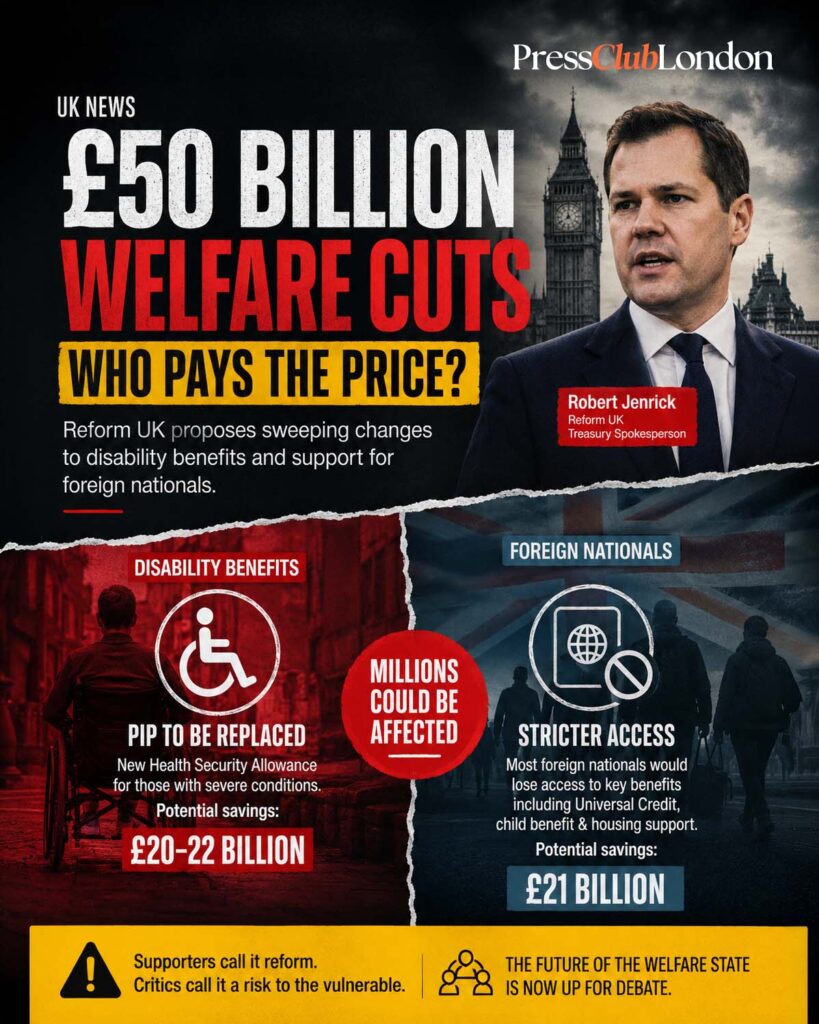
Reform UK has unveiled one of the most sweeping welfare reform proposals in recent British politics, promising to cut around £50 billion from the welfare bill if the party comes to power.
The proposals, outlined by Reform UK Treasury spokesperson Robert Jenrick, focus heavily on two groups: people receiving disability-related benefits and foreign nationals living in the UK. The party argues that the existing welfare system has become too expensive and that significant reform is necessary to encourage more people into work and reduce government spending.
A major rethink of disability benefits
A central part of the plan is a substantial restructuring of disability support.
Reform proposes replacing Personal Independence Payment, or PIP, and parts of Universal Credit’s health-related support with a new Health Security Allowance. Under the proposed system, direct financial support would be concentrated on people considered to have severe or enduring health conditions.
People with less severe conditions could instead receive support through local authority-managed Disability Support Accounts.
Reform estimates that these changes could generate roughly £20bn–£22bn in savings. However, the scale of the proposed reform means millions of existing claimants could see their support reduced or changed. Estimates reported alongside the proposals suggest around 2.89 million current PIP and Universal Credit health claimants could be affected.
This is where the debate becomes particularly sensitive. Disability campaigners argue that financial support is not simply an incentive to work; for many disabled people, it helps cover the additional costs associated with living with a disability or long-term health condition.
Foreign nationals would face major restrictions
The second major element targets welfare access for foreign nationals.
Reform proposes restricting foreign nationals from receiving most forms of welfare, including Universal Credit, housing-related benefits, pension credit and child benefit. The proposal could also affect EU citizens with settled status, creating potential complications with existing post-Brexit arrangements.
Reform estimates that restricting access in this way could generate around £21 billion in annual savings after five years.
Supporters of the proposal argue that access to welfare should be more closely linked to citizenship and contribution to the UK. Critics, however, say the policy could create significant hardship for people who are legally resident in the country and have built their lives and careers there.
The bigger question: saving money or shifting the cost?
The political argument is ultimately about more than reducing the welfare bill.
Reform says its proposals could bring more people into employment and reduce long-term pressure on public finances. The party argues that the current system is allowing too many working-age people to remain outside employment while relying on state support.
Critics take a different view. They argue that reducing benefits does not automatically remove the underlying costs associated with disability, illness, poverty or unemployment. Instead, some of those costs could potentially move elsewhere — towards local authorities, the NHS, charities, families and other public services.
The Institute for Fiscal Studies has also raised questions about the scale and practicality of the proposed savings, particularly around restrictions affecting foreign nationals and the reform of disability benefits.
A politically significant proposal
The announcement comes at a time when welfare spending, disability claims and immigration remain politically sensitive issues in Britain.
Reform UK’s proposal attempts to address all three simultaneously: reducing welfare spending, encouraging people into work and restricting benefits for foreign nationals.
But the scale of the proposed cuts means the debate is unlikely to be limited to economics. It also raises questions about the purpose of Britain’s welfare state, who should qualify for support and how far government should go when attempting to reduce public spending.
For Reform UK, the argument is about making welfare financially sustainable and changing incentives to work.
For opponents, the concern is that the approach risks placing the burden of fiscal reform on people who may have the least ability to absorb it.
With the proposals still representing a political programme rather than implemented policy, the crucial questions will be whether the projected savings can actually be achieved, how the changes would work in practice, and what their wider social and economic consequences would be.