Campaigners are calling on the UK government to close employment-law loopholes that could leave millions of gig economy workers without basic workplace protections.
Prime Minister Andy Burnham is facing growing pressure to take tougher action against gig economy companies over the way workers are classified.
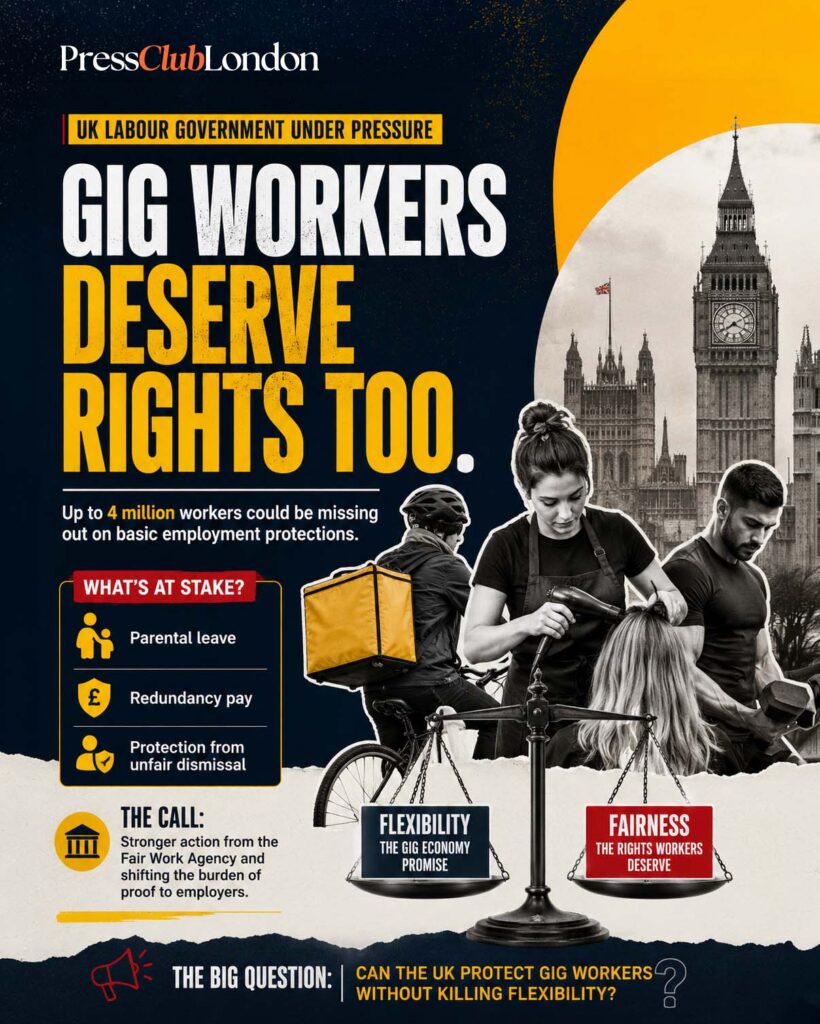
A joint report from the Fabian Society and the Joseph Rowntree Foundation argues that as many as 4 million workers could be affected by employment arrangements that leave them classified as self-employed, despite working in conditions that can resemble traditional employment.
The issue extends beyond food delivery and ride-hailing platforms. Workers such as delivery drivers, hairdressers and personal trainers can find themselves operating in a grey area between being genuinely self-employed and being dependent on a company for their income.
The employment status problem
Employment status is important because it determines which legal protections a worker receives.
People classified as self-employed generally do not receive the same employment rights as employees or workers. Depending on their status, this can mean losing access to protections such as parental leave, redundancy pay and protection from unfair dismissal.
The problem becomes particularly complicated in the platform economy, where companies can describe individuals as independent contractors while still controlling important aspects of how work is delivered.
Previous parliamentary analysis has highlighted the difficulty of applying traditional employment categories to platform-based work, where workers may have considerable flexibility but remain economically dependent on the platform providing their work.
What campaigners want
The report is calling for the newly established Fair Work Agency to make greater use of its civil enforcement powers against companies that deliberately misuse employment classifications.
Another proposed change is to shift the burden of proof. Instead of workers having to establish that they should legally be treated as employees or workers, companies would have to demonstrate why an individual should genuinely be considered self-employed.
Supporters argue that this could make it harder for businesses to use employment classifications to avoid responsibilities that come with employing people.
A difficult balance for businesses
The debate is not simply about workers versus employers.
Businesses across sectors rely on flexible labour, and the gig economy has created opportunities for people who value the ability to choose when and where they work. Policymakers therefore face the challenge of improving employment security without removing the flexibility that attracts many people to platform work.
The wider employment-rights agenda is already facing concerns from businesses over additional costs. Recent government proposals surrounding zero-hours contracts, for example, have been estimated to potentially cost businesses hundreds of millions to several billion pounds a year depending on how the reforms are implemented.
This makes the question of gig economy regulation particularly sensitive: stronger rights could improve security for workers, but businesses may argue that additional costs could affect prices, hiring and the availability of flexible work.
A test for Burnham’s government
Labour had previously proposed creating a unified “worker” status to address some of these gaps, but that proposal was dropped following political opposition. Critics now argue that without a clearer approach to employment status, other employment-rights reforms could leave a significant part of the workforce behind.
The government says it remains committed to creating more secure employment and intends to consult further on employment-status reform.
For Burnham, the challenge will be finding a workable middle ground: protecting people from exploitative employment practices while preserving legitimate flexibility for workers and businesses.
The debate also reflects a broader change in the world of work. As digital platforms continue to reshape how people find jobs, receive payments and interact with employers, traditional definitions of employment are increasingly being tested.
The question facing policymakers is no longer simply whether gig work should exist. It is how much flexibility businesses should have—and how much security workers should be guaranteed in return.