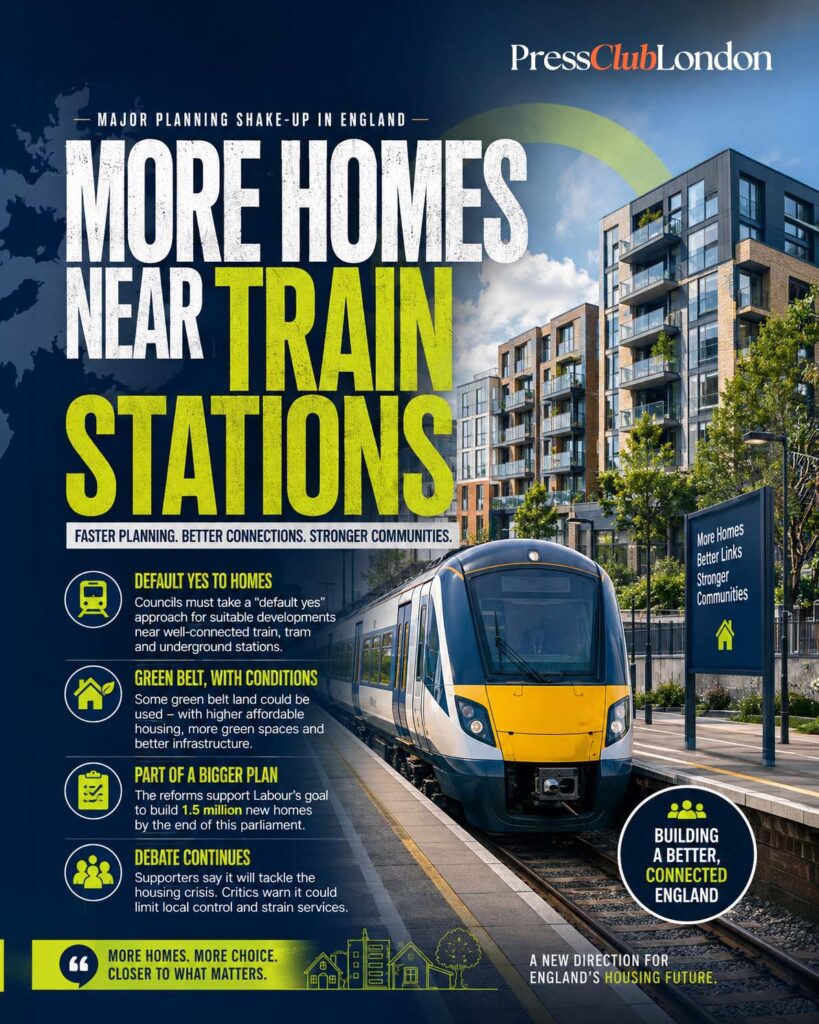
The UK government has introduced one of England’s most significant planning reforms in more than a decade, aiming to accelerate housebuilding by making it easier to develop homes around well-connected train, tram and underground stations.
Under the revised National Planning Policy Framework, councils will be expected to take a “default yes” approach to suitable housing developments within reasonable walking distance of well-connected transport hubs. Minimum expectations for housing delivery in these locations will also be introduced.
A response to the housing shortage
The policy forms part of Labour’s wider ambition to build 1.5 million new homes by the end of the current parliament. The government says it has now passed the quarter-way mark towards that target.
Housing Secretary Angela Rayner argues that increasing development around transport hubs can help people live closer to their workplaces, schools and essential services while also supporting local businesses and economic growth.
The strategy also reflects a broader planning principle: rather than spreading new housing across poorly connected locations, more development should be concentrated where public transport already exists.
Green belt land enters the debate
One of the most contentious aspects of the reforms is their potential application to green belt sites.
The government says green belt developments must meet additional “golden rules”, including higher levels of affordable housing, new or improved green spaces and the infrastructure needed to support the development.
Supporters argue that carefully selected sites near transport links could provide housing without requiring large-scale expansion into less connected areas. Critics, however, fear that the policy could weaken protections for countryside and reduce the ability of local communities to influence development decisions.
Faster planning, but more pressure on infrastructure?
The government is also reducing some blanket consultation requirements, arguing that unnecessary bureaucracy can slow down otherwise suitable developments. Expert advice will instead be focused on applications where it is considered most valuable.
That could help shorten the journey from planning application to construction. But faster planning approval does not automatically guarantee that homes will actually be built.
Transport capacity, schools, healthcare, roads, utilities and public spaces will all need to grow alongside new communities. Without sufficient infrastructure investment, concentrating thousands of additional homes around transport hubs could simply move pressure from the housing system to other public services.
A debate over local power
Opposition parties have criticised the reforms as a shift of power away from local councils and communities towards central government. The government, meanwhile, argues that clearer national planning rules are necessary to overcome inconsistencies and accelerate housing delivery.
The debate highlights one of the central tensions in British planning: how do you build enough homes quickly while still giving communities meaningful influence over how their areas change?
The government has also shown that it is prepared to adjust its approach when policies face strong opposition. On the same day as the new planning framework was announced, ministers abandoned a proposal to relax affordable-housing requirements on developments of 10–49 homes after significant opposition during consultation.
What happens next?
The new planning framework represents a major attempt to connect housing policy with transport and economic development.
If implemented effectively, building more homes around stations could create denser, better-connected communities and make use of land that already benefits from public transport.
But the real test will not be the number of planning permissions granted. It will be whether these reforms deliver affordable, well-designed homes alongside the infrastructure and public services that make communities genuinely liveable.
For England’s housing crisis, the direction is clear: build more, build faster and increasingly build where people can connect to the rest of the country without relying entirely on a car. Whether that approach can balance housing demand, environmental protection and local democracy will determine the long-term impact of the reforms.