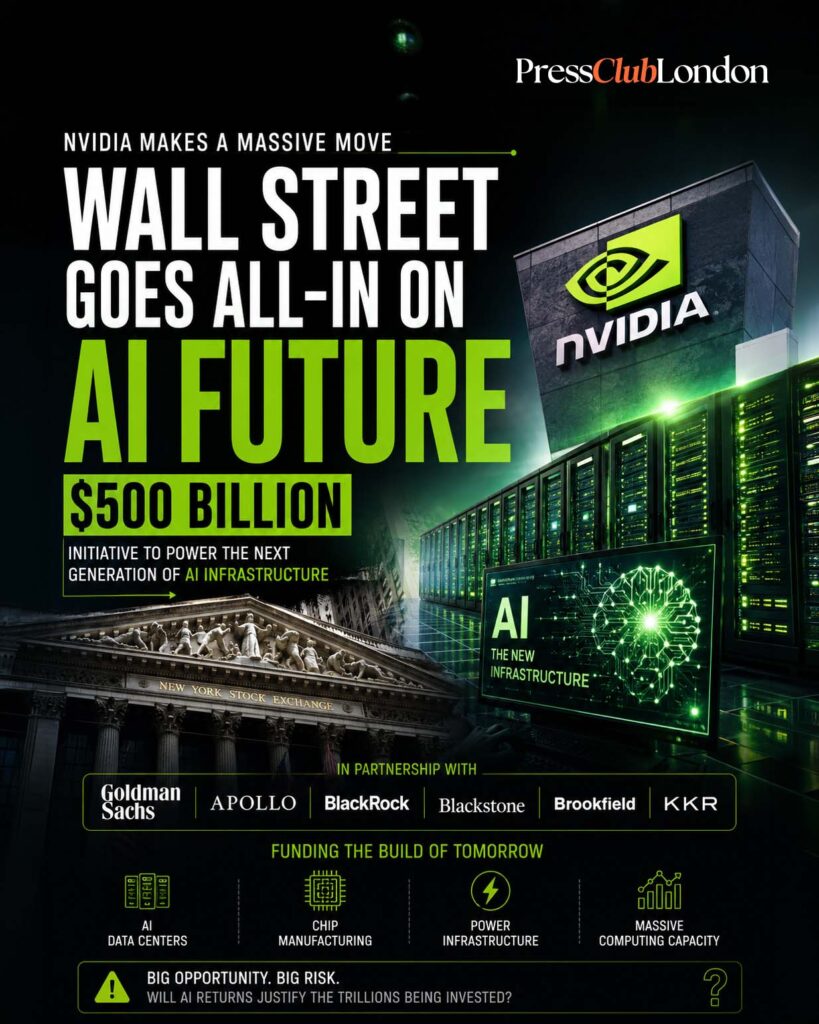
Nvidia is taking a major step beyond selling AI chips. The company has partnered with some of Wall Street’s biggest financial institutions to help mobilise more than $500 billion in capital for artificial intelligence infrastructure, marking a significant shift in how the next phase of the AI boom could be funded.
The initiative involves six major financial firms — Goldman Sachs, Apollo, BlackRock, Blackstone, Brookfield and KKR — which have signed memorandums of understanding with Nvidia. The proposed financing is intended to support the construction and expansion of AI data centres, chip manufacturing facilities and the power infrastructure required to operate them.
From AI Chips to AI Infrastructure
The development reflects how quickly the economics of artificial intelligence are changing.
The first phase of the AI boom was largely about acquiring powerful chips and developing increasingly capable models. The next phase requires something much larger: enormous amounts of computing capacity, data-centre space and electricity.
Nvidia is positioning itself at the centre of that transition.
CEO Jensen Huang has described AI data centres as the infrastructure of a new “intelligence era”, comparing their importance with infrastructure created during earlier technological transformations. The company believes that access to large pools of competitively priced capital could help businesses and governments build the computing capacity needed to develop and deploy AI systems.
The scale of the proposed financing underlines the size of the opportunity. AI-related spending is expected to exceed hundreds of billions of dollars this year, with technology companies already committing enormous amounts to data centres and computing infrastructure.
Why Wall Street Is Getting Involved
Building AI infrastructure is extremely capital-intensive.
A modern AI data centre requires not only expensive accelerators and servers but also networking equipment, cooling systems, land, construction, electricity generation and grid connections. Financing these projects through traditional corporate spending alone can place significant pressure on technology companies.
Bringing institutional investors into the equation could provide access to much larger pools of long-term capital.
For investors, meanwhile, AI infrastructure offers exposure to what could become one of the defining technology investment themes of the decade.
This is where Nvidia’s strategy becomes particularly significant. Rather than AI infrastructure being financed solely as technology spending, Nvidia is helping create a framework in which computing capacity and the infrastructure supporting it can be financed more like other large infrastructure assets.
The Financial Risk Behind the Opportunity
The size of the initiative also raises questions.
The Bank of England has warned that the rapid expansion of AI investment could create financial-stability risks, particularly if the sector becomes increasingly dependent on debt and financial institutions have limited visibility into their exposure to AI-related assets. A significant downturn in AI spending could therefore have consequences beyond technology companies and their shareholders.
There are also growing concerns about whether the extraordinary levels of spending on AI infrastructure will ultimately generate sufficient economic returns.
The underlying question is straightforward: Will the demand for AI computing grow fast enough to justify the enormous amount of infrastructure being built?
If AI adoption continues accelerating, the financing model could help remove one of the biggest barriers to expansion — access to capital.
But if demand or returns disappoint, investors and lenders could be left carrying significant exposure to expensive infrastructure projects.
A New Phase of the AI Economy
Nvidia’s move is therefore bigger than a financing agreement.
It signals a transition in the AI industry from a technology race into an infrastructure race — and increasingly, a financial one.
The companies building AI models need computing power. Data-centre operators need chips. Energy providers need investment to support rising electricity demand. Financial institutions want exposure to the growth of AI infrastructure.
Nvidia sits at the intersection of all these trends.
The company has already benefited enormously from the AI boom through demand for its processors and related technology. By helping bring Wall Street capital into the infrastructure layer, it could further strengthen its position in the ecosystem that supports AI growth.
At the same time, the move illustrates why the AI boom is attracting increasing scrutiny. The more capital that flows into AI infrastructure, the greater the potential rewards — but also the greater the financial consequences if expectations fail to materialise.
For now, Nvidia’s $500 billion financing initiative represents a powerful vote of confidence in the future of AI.
It also marks a clear sign that the AI revolution is no longer just a technology story.
It is becoming an infrastructure and financial story too.