Artificial intelligence is advancing faster than many existing laws and regulatory systems can keep up with. In the UK, that gap is now becoming a major political and human rights concern.
A cross-party group of MPs and peers has called for new legislation to establish stronger protections against the potential harms of artificial intelligence, arguing that the UK’s current legal and regulatory framework is not equipped to deal with the technology’s growing capabilities.
A Call for a New AI Bill
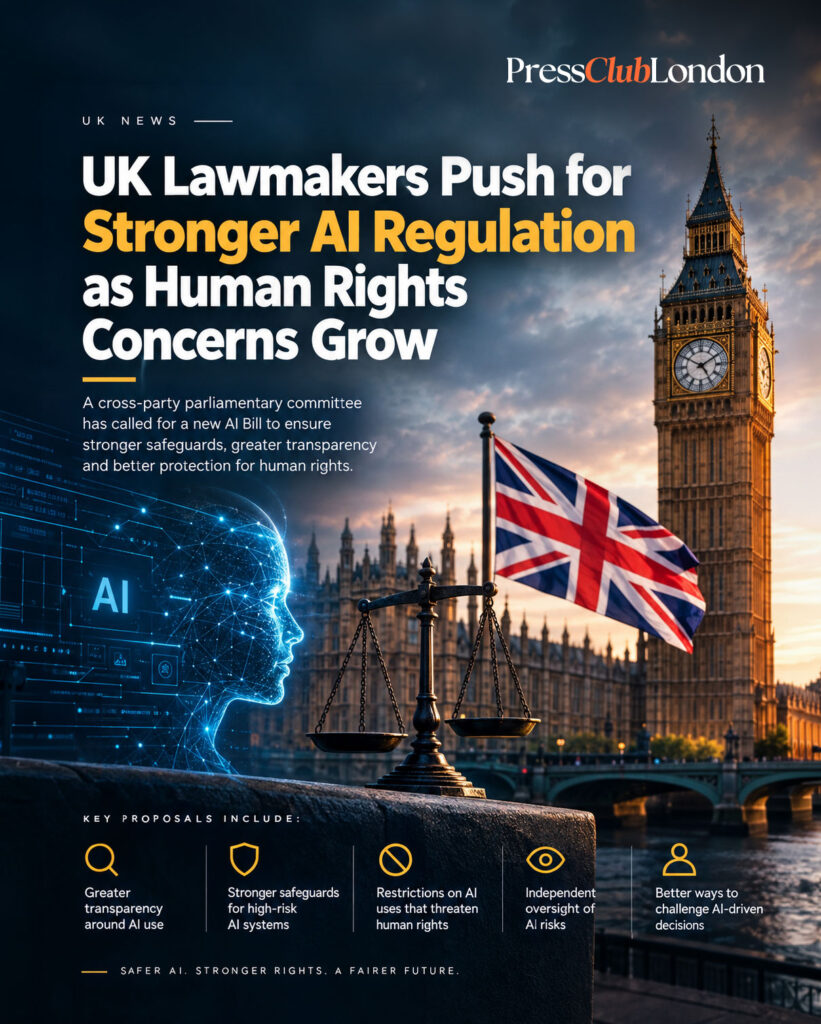
The Joint Committee on Human Rights (JCHR) has recommended a new AI Bill that would introduce a more comprehensive regulatory framework covering the development and use of AI.
The committee argues that existing rules often focus on how AI is used rather than placing sufficient responsibility on the companies and organisations developing increasingly powerful systems.
Among its recommendations are stronger obligations for high-risk AI systems, mandatory transparency requirements and restrictions on AI applications that are incompatible with human rights. It has also called for an independent oversight body with meaningful enforcement powers.
The committee’s concerns extend beyond hypothetical future risks. AI can already influence decisions involving employment, privacy, access to services and other areas of people’s lives. Lawmakers want individuals to know when AI is being used to make decisions affecting them and to have meaningful ways to challenge those decisions.
Why Human Rights Are at the Centre of the Debate
The regulatory discussion is increasingly moving beyond questions of innovation and economic competitiveness.
Privacy, surveillance, discrimination, transparency and access to legal remedies are becoming central issues.
The JCHR has argued that existing frameworks may struggle to address these risks because AI systems can operate across complex supply chains involving developers, deployers and users. That makes it difficult to determine who should be responsible when an AI system causes harm.
The committee therefore wants regulation to cover the entire AI lifecycle rather than focusing solely on the final user.
AI Companies Are Also Calling for Greater Oversight
Interestingly, calls for stronger regulation are not coming only from politicians and civil society.
Anthropic CEO Dario Amodei recently argued that the development of frontier AI should be paced more carefully because capabilities are advancing rapidly. OpenAI has also urged UK lawmakers to introduce targeted regulation focused on the most powerful AI systems rather than imposing identical requirements on every AI company.
That creates an unusual situation: some of the companies developing the world’s most advanced AI systems are themselves calling for governments to establish stronger safeguards.
However, regulation also raises an important question: how can governments protect society without creating rules that unintentionally prevent useful innovation or strengthen the position of the largest technology companies?
The UK’s Regulatory Balancing Act
The UK has so far favoured a relatively flexible, context-based approach to AI regulation, relying heavily on existing regulators and targeted interventions rather than creating a single comprehensive AI law.
The government has maintained that AI should be regulated according to the context in which it is used, while also emphasising international cooperation on AI safety.
The new parliamentary report puts pressure on that approach.
Its message is not necessarily that AI development should stop. Instead, it argues that the regulatory framework needs to become capable of dealing with the scale and speed of technological change.
That distinction is important.
Effective AI regulation does not have to mean stopping innovation. It can mean establishing clear boundaries around unacceptable uses, requiring greater transparency from developers and ensuring that powerful systems can be independently evaluated.
Why This Matters for Businesses
The debate will eventually affect more than AI laboratories and technology companies.
Businesses adopting AI for recruitment, customer service, finance, marketing, decision-making and internal operations may increasingly have to consider transparency, accountability, data protection and risk management.
For companies, the emerging lesson is straightforward: adopting AI should not simply be a technology decision. It is increasingly a governance and business-risk decision as well.
Organisations that build responsible AI practices early may be better positioned as regulation develops.
The Bigger Question
The UK now faces a difficult balancing act.
AI has the potential to transform healthcare, research, productivity and business. At the same time, increasingly capable systems can create new risks that traditional regulation was never designed to address.
The latest parliamentary intervention suggests that policymakers believe waiting for those risks to become widespread before acting could be too late.
The real challenge, therefore, is not simply deciding whether AI should be regulated.
It is deciding how much oversight is necessary, who should be accountable, and how quickly governments can build rules that keep pace with the technology.
For the UK, that conversation is becoming increasingly urgent.