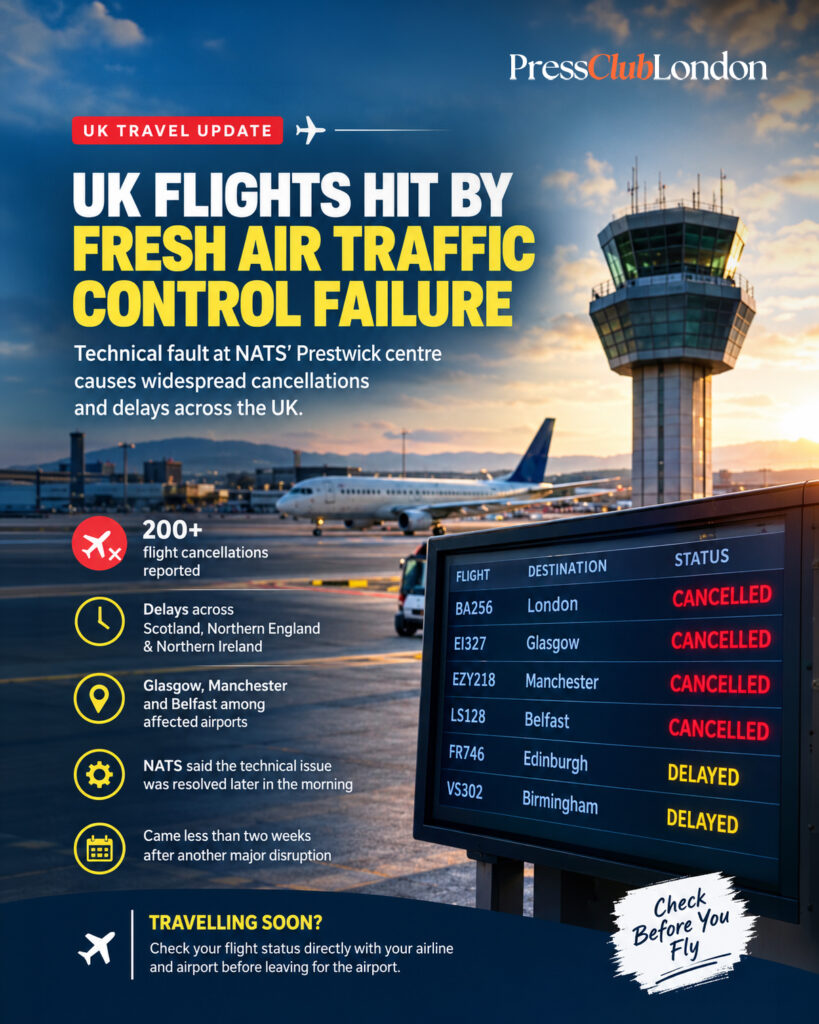
A fresh technical failure at the UK’s air traffic control system caused widespread flight disruption on Monday, 21 September, leaving passengers facing cancellations and lengthy delays across parts of the country.
The problem occurred at the National Air Traffic Services (NATS) control centre in Prestwick, Scotland. Although the fault was resolved later in the morning, its effects continued to ripple through airline schedules and airports as operators worked to recover from the disruption.
More than 200 flights affected
The disruption primarily affected airspace covering Scotland, Northern England and Northern Ireland. Major airports including Manchester, Glasgow and Belfast experienced disruption, while airlines were forced to cancel flights and reorganise schedules.
Cirium data cited by the Associated Press indicated that 227 flights had been cancelled by late afternoon. The impact was particularly significant because even after an air-traffic-control restriction is removed, aircraft, crews and airport slots can remain out of position, creating knock-on delays throughout the day.
NATS said the technical problem had been fixed and that it was working with airports and airlines to lift restrictions safely and minimise further disruption. The organisation also said the latest incident was unrelated to the technical problem experienced earlier in September.
Why an air traffic control failure has such a wide impact
Air traffic control is a critical part of the aviation network because it determines how many aircraft can safely enter and move through particular areas of airspace.
When a technical problem reduces the capacity of an air traffic control centre, controllers may have to introduce restrictions on the number of aircraft entering affected airspace. That can quickly translate into delayed departures, aircraft being held on the ground, cancellations and missed connections.
The disruption can also continue after the original fault has been resolved. An aircraft arriving late may subsequently operate its next flight late, while crews and aircraft can become displaced from their planned locations. This creates a chain reaction that can extend well beyond the airport or region where the original problem occurred.
A second disruption in a matter of weeks
The latest failure has attracted particular attention because it followed another major NATS-related disruption earlier in September.
The recurrence has intensified questions from airlines about the resilience of the UK’s air traffic control infrastructure and the effectiveness of contingency arrangements.
Airlines including Ryanair, easyJet, British Airways and Jet2 have publicly criticised the disruption. Ryanair has gone further by calling for NATS chief executive Martin Rolfe to resign, while other airlines have called for urgent improvements and greater accountability. These are positions expressed by the companies and should be distinguished from the findings of the independent review.
Government orders independent review
The repeated disruption has also increased scrutiny from the UK government.
Transport Secretary Heidi Alexander commissioned an independent review into the recurring problems at NATS. The review is expected to examine what caused the incidents, how resilient the existing systems are and whether further safeguards are required.
The government’s involvement is significant because NATS operates critical national infrastructure and the reliability of the air traffic control network has consequences extending beyond individual airlines and airports.
What it means for passengers
For passengers, the immediate priority is to check flight information directly with their airline or airport before travelling.
Travellers affected by cancellations or significant delays may have rights to assistance or alternative travel depending on the circumstances. However, the Civil Aviation Authority has indicated that compensation may not normally be payable where disruption results from circumstances considered outside an airline’s control, such as certain air traffic control failures.
Passengers should therefore distinguish between compensation and care or rerouting rights, which can operate differently depending on the circumstances.
A warning about infrastructure resilience
The latest incident raises a broader question for the UK’s aviation sector: how much disruption can the network absorb when a critical technology system fails?
Modern aviation depends heavily on interconnected digital infrastructure. While technical failures are inevitable in complex systems, resilience depends on redundancy, backup systems, rapid recovery procedures and the ability to maintain services when part of the network becomes unavailable.
The fact that another significant disruption occurred within a short period makes the upcoming independent review particularly important. Its findings should help establish whether the incidents were isolated technical failures or evidence of wider weaknesses that require investment or operational changes.
For now, the immediate fault at Prestwick has been resolved, but the disruption has left airlines, airports, regulators and passengers focused on a larger issue: ensuring that a technical problem at one critical facility does not cascade into widespread disruption across the UK’s aviation network.