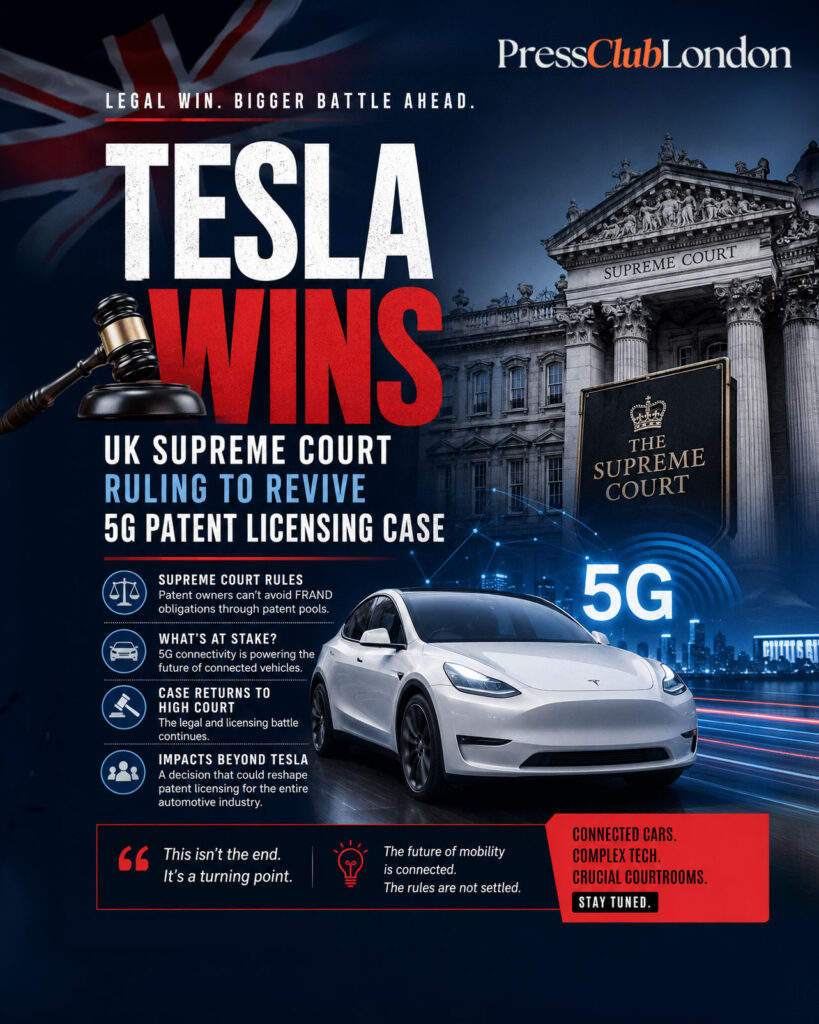
Tesla has secured an important legal victory in the UK in its long-running dispute over licensing fees for 5G technology used in connected vehicles.
The UK Supreme Court ruled in Tesla’s favour, allowing the electric vehicle maker to revive its lawsuit concerning the licensing of patents essential to cellular connectivity. The case, originally filed in London’s High Court in 2023, involves U.S. technology company InterDigital and Avanci, a platform that licenses patent portfolios for automotive applications.
At the heart of the dispute is the principle of FRAND licensing — meaning that patents considered essential to industry standards should be licensed on fair, reasonable and non-discriminatory terms.
Tesla had sought a court determination of the licensing terms for patents it needs as it prepares to introduce 5G-enabled vehicles in Britain. The automaker’s position was challenged after the High Court rejected its request for a FRAND ruling in 2024. Tesla subsequently lost an appeal at the Court of Appeal before taking the matter to the UK’s highest court.
The Supreme Court’s ruling has now changed the direction of the case. It determined that patent owners do not avoid their FRAND obligations simply because their patents are included in a patent pool or licensing platform.
The decision is significant for the automotive industry because connected vehicles increasingly rely on telecommunications technologies. Modern cars are evolving into connected computing platforms, requiring access to technologies that are often protected by large portfolios of standard-essential patents.
For automakers, the cost and structure of patent licensing can therefore become an important part of developing and selling connected vehicles. For patent owners, licensing revenue represents the commercial value of the technologies they have developed and patented.
Tesla’s victory, however, is not the final outcome of the dispute. The case is expected to return to the High Court, where the underlying licensing issues will continue to be examined. Avanci has expressed disagreement with the Supreme Court’s decision and maintains that Tesla’s claims are without merit.
The case could ultimately have implications beyond Tesla. As 5G connectivity becomes increasingly integrated into vehicles and the automotive industry moves towards software-defined and connected cars, disputes over technology licensing are likely to become more important.
The ruling therefore represents more than a legal win for one automaker. It highlights a growing tension at the intersection of the automotive, telecommunications and intellectual property industries — and could influence how connected-car technologies are licensed in the future.