A new step towards personalised and customer-driven banking
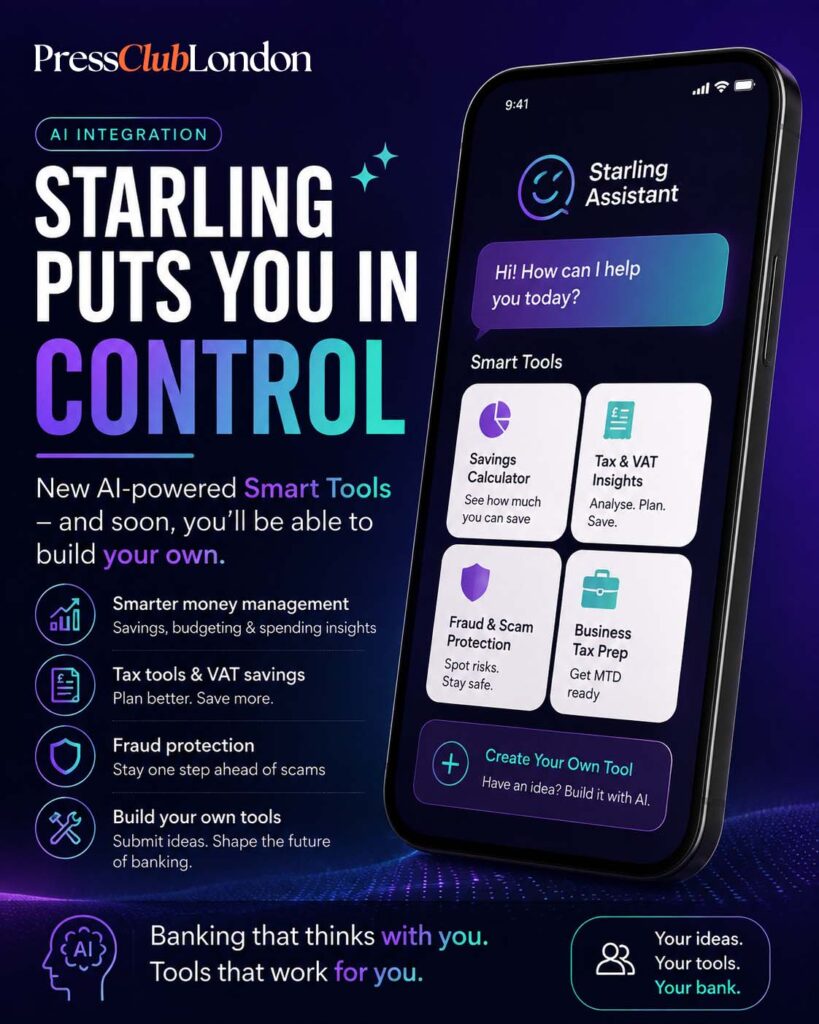
Artificial intelligence is increasingly becoming part of everyday banking, but Starling Bank is taking the concept a step further. The UK digital bank has introduced a new suite of AI-powered “Smart Tools” and plans to allow customers to create their own custom tools as part of its wider AI integration.
The initiative is built around Starling Assistant, the bank’s agentic AI assistant. Instead of expecting customers to work out what to ask an AI system, Smart Tools are designed around specific financial tasks, using pre-programmed prompts that can be activated more easily.
What are Starling’s Smart Tools?
Starling plans to introduce new Smart Tools on a regular basis, covering practical areas of personal and business finance.
The initial tools include features focused on:
- Tax analysis and VAT savings
- Personalised savings calculations
- Spending and budgeting support
- Student budget planning
- Fraud and scam protection
- Helping businesses prepare for Making Tax Digital
Some tools can analyse a customer’s financial activity to provide more personalised guidance. For example, Starling has outlined tools that can assess income, direct debits and spending patterns to help customers determine how much they may realistically be able to save.
From using AI to creating with AI
The more significant part of Starling’s announcement is its plan to allow customers to build their own Smart Tools.
Customers will be able to submit ideas and, according to the initial announcement, Starling intends to explore making crowdsourced concepts available more widely. This could create a more participatory approach to banking technology, where customers help identify the financial problems that new AI features should solve.
This represents a shift from the traditional banking model. Instead of a bank developing every feature internally and presenting customers with a fixed set of options, AI could make it possible for users to shape parts of their own banking experience around their individual needs.
Removing the “what should I ask?” problem
One of the biggest barriers to consumer AI adoption is often not the technology itself, but knowing how to use it.
A general-purpose AI assistant can offer countless possibilities, which can sometimes leave users unsure about what to ask. Starling’s Smart Tools approach attempts to reduce that uncertainty by presenting clear, specific tasks that customers can activate directly.
The bank has described this as a way to remove the guesswork around AI and make its capabilities more accessible to customers who may be interested in AI but are not comfortable writing detailed prompts.
This could be particularly important in financial services, where customers may want practical help rather than an open-ended conversation with an AI system.
The rise of agentic AI in banking
Starling’s strategy also reflects the growing interest in agentic AI.
Unlike a conventional chatbot that mainly provides information, an agentic system can help carry out actions. Starling Assistant already uses natural-language interactions to support tasks such as creating budgets, setting up savings plans, managing banking Spaces and reviewing direct debits.
The Smart Tools programme builds on this model by packaging individual capabilities around specific customer needs.
In simple terms, the evolution looks like this:
Traditional banking apps → AI-powered assistance → AI that can perform tasks → personalised AI tools created around individual needs.
Why this matters for the future of fintech
Starling’s move is significant because it explores a more personalised model for AI-powered financial services.
For years, digital banks have competed by introducing features such as instant notifications, spending insights, budgeting tools and automated savings. AI could create the next level of differentiation by allowing banking experiences to become increasingly tailored to individual customers.
The ability for customers to suggest or eventually build their own tools could also provide banks with a new source of product innovation. Instead of relying entirely on internal teams to identify customer needs, banks may increasingly use AI platforms to understand what customers actually want help with.
However, greater personalisation will also require strong controls. Banking is a regulated industry, and AI-powered tools involving money management, tax-related information and fraud protection need to operate within appropriate security, privacy and compliance frameworks.
The bigger picture
Starling Bank’s Smart Tools initiative shows how AI in banking may move beyond simply adding a chatbot to a mobile app.
The focus is increasingly shifting towards useful, task-specific and personalised AI experiences. By combining pre-built tools with plans for customer-created features, Starling is experimenting with a model where customers could play a more active role in shaping the technology they use to manage their money.
The long-term success of this approach will depend on how useful, reliable and easy these tools are for everyday customers. But the direction is clear: the next generation of banking apps may become less about navigating menus and more about simply telling an intelligent system what you want to achieve.
As AI becomes more capable of understanding financial needs and carrying out tasks, personalised banking could move from being a premium feature to becoming a core part of the digital banking experience.