A Royal Navy warship that disappeared beneath the waters off the Isle of Wight more than a century ago has finally been found.
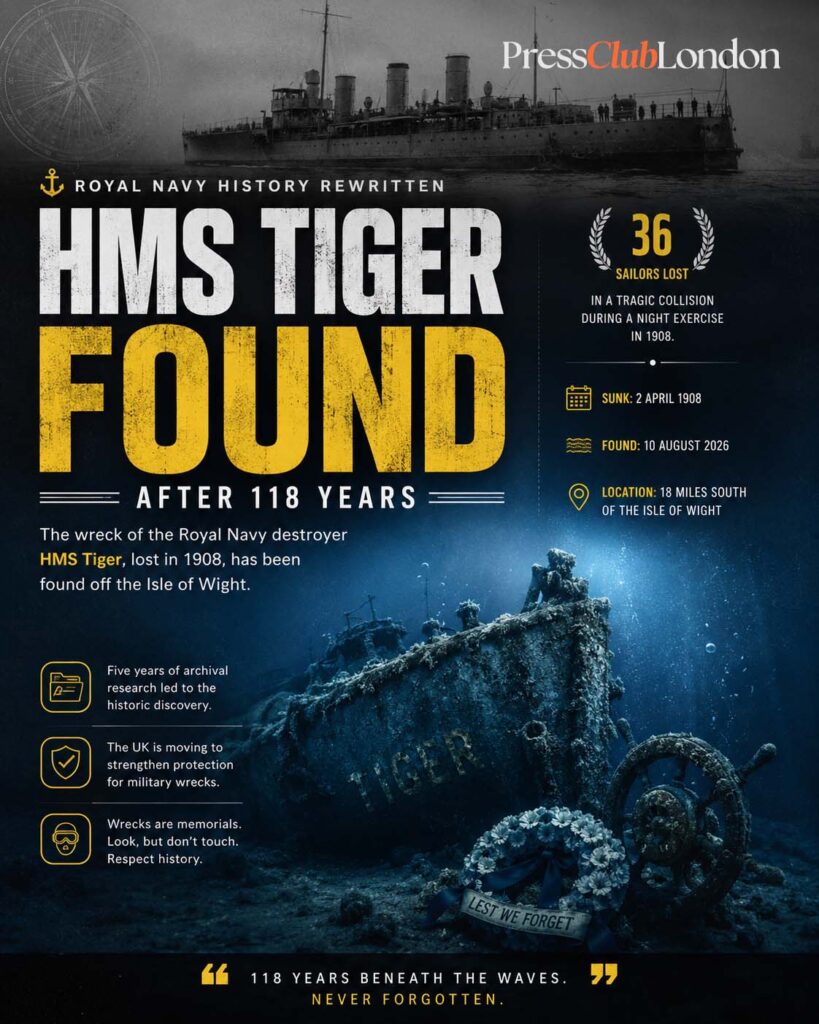
The wreck of HMS Tiger, a 400-ton torpedo boat destroyer, was located by ProjectXplore, a team of divers and maritime historians who spent five years researching naval archives to determine where the ship had sunk in 1908.
The discovery brings an end to a 118-year-old maritime mystery—and also shines a light on the human cost of an accident that claimed 36 lives.
A Tragedy During a Night Exercise
HMS Tiger was built by John Brown & Company at Clydebank and launched in 1900 before entering Royal Navy service in 1901. She was designed as a fast torpedo boat destroyer capable of reaching around 30 knots.
On the night of 2 April 1908, Tiger was taking part in a Royal Navy training exercise in the English Channel, around 18 miles south of the Isle of Wight.
The exercise involved ships conducting a simulated night attack without navigation lights. During the manoeuvre, Tiger crossed into the path of the much larger HMS Berwick, a roughly 10,000-ton cruiser.
There was little time for either ship to react.
Berwick struck Tiger amidships with such force that the destroyer was effectively cut in two. Its bow sank almost immediately, while the stern remained afloat for only around three minutes before disappearing beneath the waves.
Of the 57 people aboard, fewer than half survived. The tragedy included the loss of Tiger’s captain, Lieutenant W. E. Middleton.
A Wreck Lost for More Than a Century
Despite the circumstances surrounding the sinking, the exact location of HMS Tiger remained unknown for generations.
That changed after ProjectXplore began a detailed investigation into historical records. Rather than relying solely on underwater searching, the team spent five years studying archives and piecing together historical information to narrow down the likely location of the wreck.
The discovery was announced on 10 August 2026, 118 years after the disaster.
The divers also paid tribute to the sailors who died by laying a ceremonial wreath on the ship’s tiller.
For maritime historians, the wreck offers more than an opportunity to locate a forgotten ship. It provides a tangible link to an important period in Royal Navy history, when naval forces were developing new tactics, faster vessels and increasingly sophisticated approaches to fleet warfare.
Why the Discovery Matters Today
The timing of the discovery is particularly significant.
The UK Government is seeking to strengthen legal protection for military shipwrecks through the Armed Forces Bill. Under the proposed changes, newly discovered military wrecks could receive automatic protection from the moment they are identified.
That would make it an offence to disturb or remove objects from protected military wreck sites without permission, while still allowing responsible divers to visit them under a “look but don’t touch” principle.
The proposed changes would also expand protection to older military wrecks that currently fall outside the scope of existing legislation.
This is important because shipwrecks such as HMS Tiger are not simply archaeological objects. They can also serve as underwater memorials to people who lost their lives at sea.
Preserving History Beneath the Waves
The discovery of HMS Tiger demonstrates how modern technology, diving expertise and historical research can work together to recover pieces of the past that were thought to be lost forever.
But finding a wreck does not necessarily mean recovering it.
In the case of HMS Tiger, preservation is now the priority. The Royal Navy has stressed that divers can visit military wrecks, but should do so without disturbing them.
After 118 years beneath the English Channel, HMS Tiger has finally been located.
More importantly, the discovery gives the 57 people aboard the destroyer—and particularly the 36 who never returned home—a place that can once again be remembered.
The wreck may have remained hidden for more than a century, but the story of HMS Tiger is no longer lost.