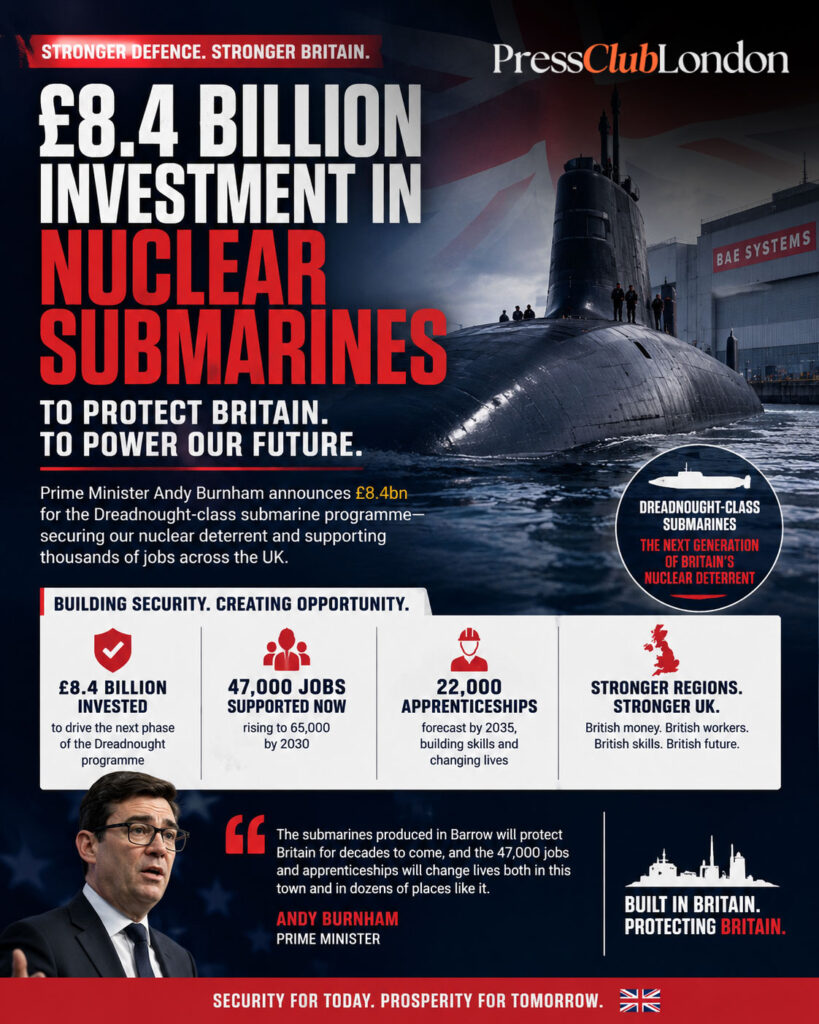
The UK government has reaffirmed its commitment to the nation’s nuclear deterrent with an £8.4 billion investment in the Dreadnought submarine programme, a move Prime Minister Andy Burnham says will strengthen national security while supporting thousands of skilled jobs across the country.
Speaking ahead of a visit to Barrow-in-Furness, where the next generation of Dreadnought-class submarines is being constructed, Burnham emphasized that defence spending should deliver both security and economic value.
“Security is not only about what we build, it is about who builds it, and who benefits from it,” the Prime Minister said.
A Major Investment in Britain’s Nuclear Future
The £8.4 billion funding package will support the next phase of the Dreadnought programme, which is designed to replace the Royal Navy’s Vanguard-class submarines. The Vanguard fleet has provided the UK’s continuous at-sea nuclear deterrent since the early 1990s and is expected to retire during the 2030s.
The Dreadnought submarines will carry the UK’s Trident nuclear missile system and are intended to maintain the country’s strategic nuclear deterrence capability for decades to come.
The investment forms part of a wider £63.6 billion Defence Nuclear Enterprise programme planned over the next four years. This broader initiative covers submarine operations, infrastructure upgrades, future submarine development, naval dockyard improvements, and defence manufacturing expansion.
Defence Spending Meets Economic Growth
A key theme of Burnham’s announcement is the economic impact of defence investment. The government estimates that the UK’s nuclear defence sector currently supports around 47,000 jobs, with that figure expected to increase to 65,000 by 2030.
The programme is also forecast to support approximately 22,000 apprenticeships by 2035, creating new opportunities for young people entering technical and engineering careers.
Barrow-in-Furness, home to the UK’s submarine-building industry, is expected to remain one of the primary beneficiaries of the investment. However, the government argues that the supply chain extends far beyond Cumbria, supporting businesses, manufacturers, and skilled workers across multiple regions of the UK.
Questions Over Defence Funding Remain
While there is broad political support for maintaining the Dreadnought programme, debate continues over the UK’s future defence spending commitments.
The government has pledged to meet NATO’s target of spending 3.5% of national income on defence by 2035. However, questions remain regarding a separate target to increase defence spending to 3% of GDP and how such commitments will be funded.
Defence Secretary Wes Streeting declined to provide a timeline for reaching the 3% target, stating that future spending commitments would be announced alongside clear funding plans.
The challenge for Burnham and Chancellor John Healey will be balancing defence priorities with wider public spending pressures while maintaining fiscal discipline.
Political Reactions
The announcement drew mixed reactions across the political spectrum.
Conservatives welcomed progress on the submarine programme but argued that the government has yet to fully commit to long-term defence funding.
The Liberal Democrats called for new defence bonds to raise dedicated military funding, while Reform UK criticized the announcement as a continuation of existing plans rather than a comprehensive overhaul of the UK’s nuclear strategy.
Meanwhile, the Green Party questioned the value of investing billions into nuclear weapons systems, arguing that public funds could be directed toward alternative forms of employment creation and public services.
Strategic Importance
The Dreadnought programme remains one of the largest and most significant defence projects in modern British history. First proposed in 2006 and formally approved by Parliament in 2016, the project represents a long-term commitment to maintaining the UK’s independent nuclear deterrent.
Beyond its military role, the programme highlights the increasing link between defence policy, industrial strategy, skills development, and regional economic growth.
As global security challenges continue to evolve, the UK government is positioning defence investment not only as a means of protecting the nation but also as a catalyst for jobs, apprenticeships, and industrial development across the country.