Artificial intelligence is becoming a far more common part of British business. But new data suggests that widespread adoption is not yet translating into deep, organisation-wide transformation.
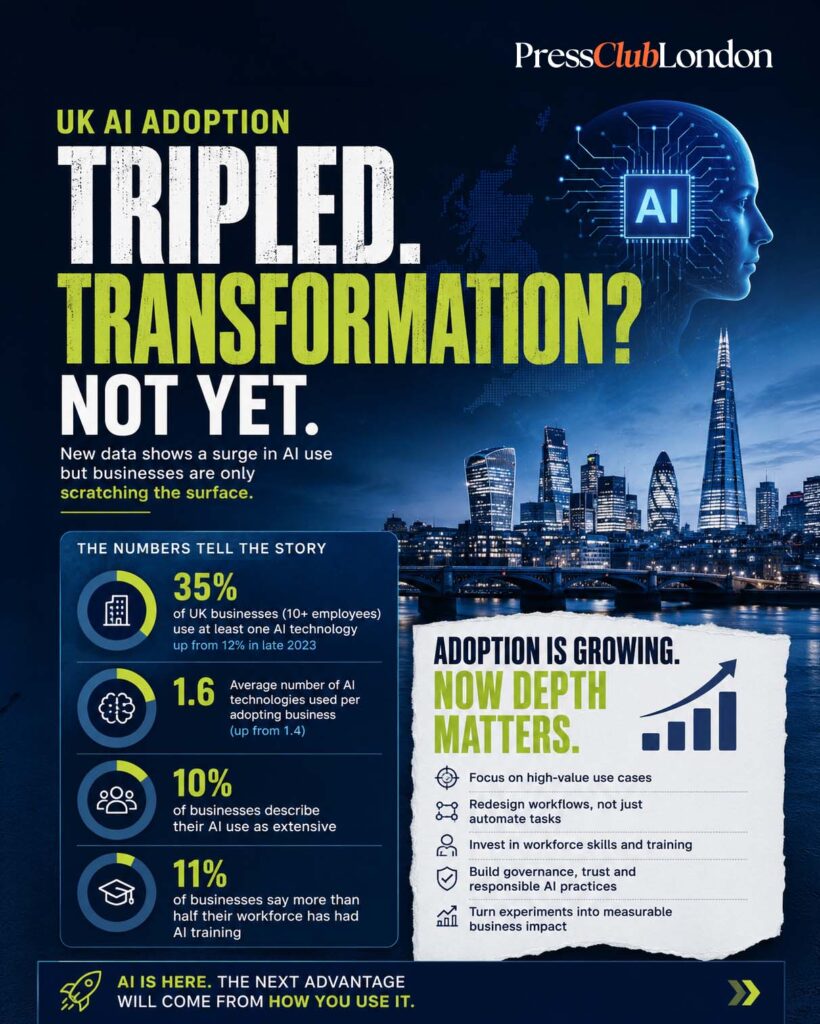
According to data from the Office for National Statistics (ONS), 35% of UK businesses with 10 or more employees were using at least one AI technology by June 2026. That is a significant increase from 12% in late 2023, meaning business adoption has nearly tripled in less than three years.
However, the data also reveals a major gap between using AI and building a business around it.
The average AI-adopting business uses just 1.6 AI technologies, compared with 1.4 previously. Only around 10% of businesses describe their AI use as extensive, while workforce training remains limited, with only 11% reporting that more than half of their employees have received AI-related training.
Adoption Is Growing Faster Than Integration
The rapid rise in AI adoption shows that British businesses are clearly interested in the technology. Generative AI tools, automation platforms and AI-powered software have become easier to access, allowing companies to experiment without making major infrastructure investments.
But experimentation is not the same as transformation.
For many organisations, AI appears to be concentrated in individual tasks rather than embedded across core workflows. Employees may use AI to draft content, analyse information, write code or automate routine work, while the wider business continues to operate in much the same way.
This creates an important distinction: AI is spreading across organisations, but it is not necessarily going deep within them.
The gap is also visible in the difference between employer-led adoption and employee behaviour. Data highlighted in the analysis shows that 55% of employees say they use AI for work, compared with 35% of businesses formally reporting AI adoption.
That suggests a significant amount of AI usage may be happening informally, outside structured company-wide strategies.
The Real Challenge Is Moving Beyond the AI Experiment
The next stage of AI adoption will not simply be about giving more employees access to new tools.
Businesses will need to answer more fundamental questions:
- Where can AI create measurable business value?
- Which workflows should be redesigned rather than simply automated?
- How can employees be trained to use AI effectively?
- What governance is needed around data, privacy and accuracy?
- How can successful experiments be scaled across the organisation?
Research published earlier in 2026 has pointed to a similar pattern: AI use is increasing, but integration into core business processes remains comparatively shallow.
This means that the companies likely to benefit most from AI may not necessarily be those using the largest number of tools. Instead, the advantage could go to businesses that identify specific problems and redesign their workflows around AI in a structured and measurable way.
Training Could Be the Missing Piece
Technology alone is unlikely to deliver meaningful transformation.
If employees are given AI tools without proper training, businesses risk creating inconsistent usage, unreliable outputs and missed opportunities. The ONS-related figures showing limited large-scale workforce training highlight how much work remains to be done.
AI adoption therefore needs to be accompanied by investment in people.
Employees need to understand not only how to use AI tools, but also when to trust them, when to verify outputs and how AI can fit into their specific roles. Leaders, meanwhile, need a clearer understanding of where AI can improve productivity, customer experience, decision-making or innovation.
From AI Adoption to AI Transformation
The UK has made substantial progress in bringing AI into the workplace. Moving from 12% adoption to 35% in less than three years represents a significant shift.
But the latest figures suggest that Britain’s AI journey is still in an early phase.
The challenge ahead is not simply to convince more businesses to use AI. It is to help existing adopters move beyond isolated tools and experiments towards meaningful integration.
AI may already be present in the workplace, but for many organisations, it has yet to fundamentally change the way work gets done.
The next phase of the AI race will therefore be defined less by who adopts AI first and more by who learns how to use it deeply, responsibly and strategically.