British households are facing renewed pressure on their finances as rising energy bills drive inflation higher, raising concerns that the UK could be heading towards another cost-of-living crisis.
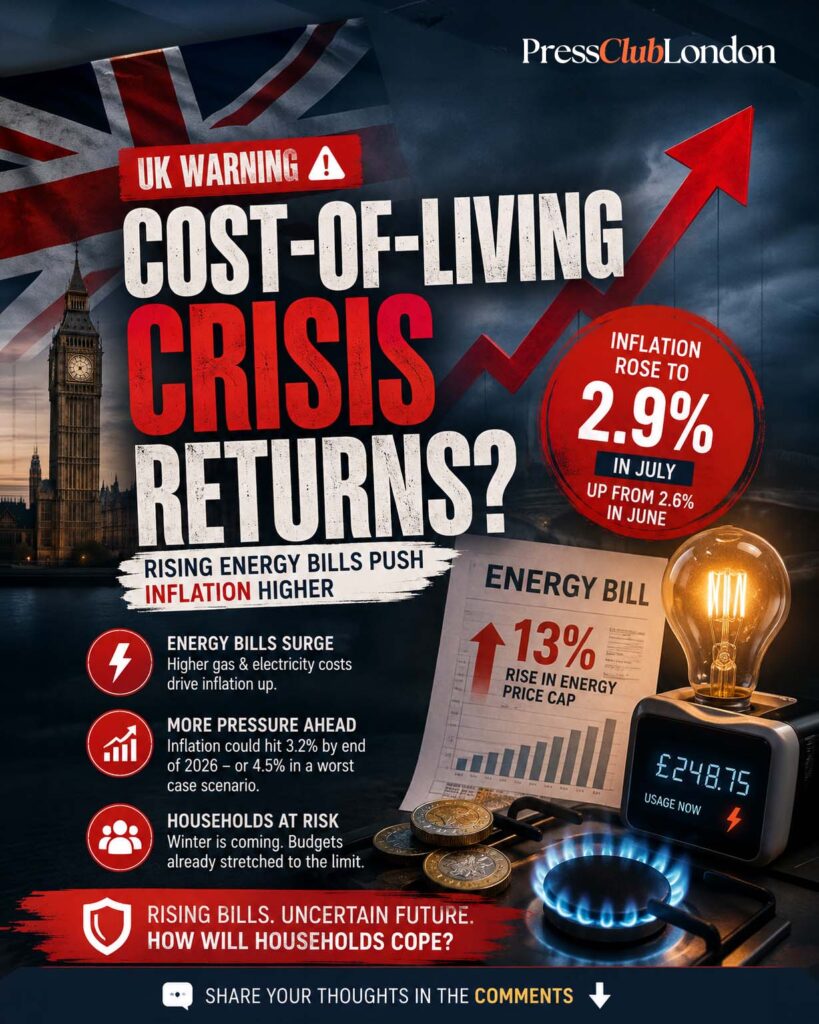
Official figures released on 19 August showed UK inflation rising to 2.9% in July, up from 2.6% in June. The increase matched economists’ forecasts and was largely driven by a sharp rise in household gas and electricity costs following a 13% increase in Ofgem’s energy price cap in July.
The development comes at a difficult time for households already dealing with high living costs. The increase in energy prices represents the sharpest summer rise in household energy bills in four years, adding fresh pressure to family budgets just months before the winter season.
Energy Prices at the Centre of the Inflation Surge
The latest inflation figures highlight how vulnerable household finances remain to developments in global energy markets.
The ongoing conflict involving Iran has created renewed instability in oil and gas markets, with disruptions and geopolitical tensions feeding through into energy costs. While inflation had been expected to move closer to the Bank of England’s 2% target, the latest energy shock has reversed that trend.
Gas prices were a major factor behind July’s increase, while reduced seasonal discounting on items such as clothing and furniture also contributed to higher consumer prices. At the same time, lower fuel prices provided some relief and partially offset the overall increase.
For households, however, the concern is straightforward: when essential bills rise, there is less money available for food, transport, savings and other everyday spending.
A Difficult Challenge for the UK Economy
The inflation rebound creates a complicated situation for policymakers.
The Bank of England must now balance the risk of persistent inflation against signs that the UK labour market is cooling. Wage growth slowed in June, while job vacancies fell to a five-year low, suggesting that parts of the economy are already losing momentum.
Raising interest rates could help contain inflation, but it could also increase borrowing costs for households and businesses. Higher mortgage payments and more expensive loans would add another layer of financial pressure at a time when energy costs are already rising.
The Bank of England has warned that inflation could reach 3.2% before the end of 2026, while a severe escalation in Middle East tensions could potentially push inflation as high as 4.5% by the middle of 2027 under a worst-case scenario.
Government Under Pressure to Protect Households
The government has introduced measures designed to provide some relief, including a VAT reduction on electricity intended to reduce average consumer bills by about £45 a year from October. A £2 cap on bus fares in England is also expected to provide modest support for household budgets.
However, the scale of the latest energy-driven inflation increase means these measures could be overshadowed if prices continue to rise.
The government is also approaching a challenging autumn budget, with rising inflation, borrowing costs and pressure to support households all competing for attention. The UK economy showed resilience during the first half of 2026, but growth slowed to 0.4% in the second quarter, compared with 0.6% in the first quarter, as higher energy costs and global uncertainty began to weigh on the economy.
Is Another Cost-of-Living Crisis Beginning?
The latest figures do not necessarily mean the UK is returning immediately to the severe inflation levels experienced during the previous cost-of-living crisis. Underlying inflation pressures have shown some signs of easing, with core inflation holding at 2.6% and services inflation falling to 3.4% in July.
However, the biggest risk lies outside the direct control of British policymakers.
Energy markets remain vulnerable to further geopolitical disruption, while extreme weather affecting global food production could create additional inflationary pressure. If energy costs remain elevated and food prices begin rising again, household budgets could face another sustained period of financial stress.
For millions of UK households, the key question will not simply be whether inflation reaches a particular target. It will be whether wages and incomes can keep pace with the rising cost of essentials.
With winter approaching, energy bills climbing and global uncertainty continuing, the UK’s cost-of-living challenge may be entering a new and increasingly difficult phase.
The July inflation rise from 2.6% to 2.9% is a warning that the pressure on household finances has not disappeared—it may simply be returning in a new form.