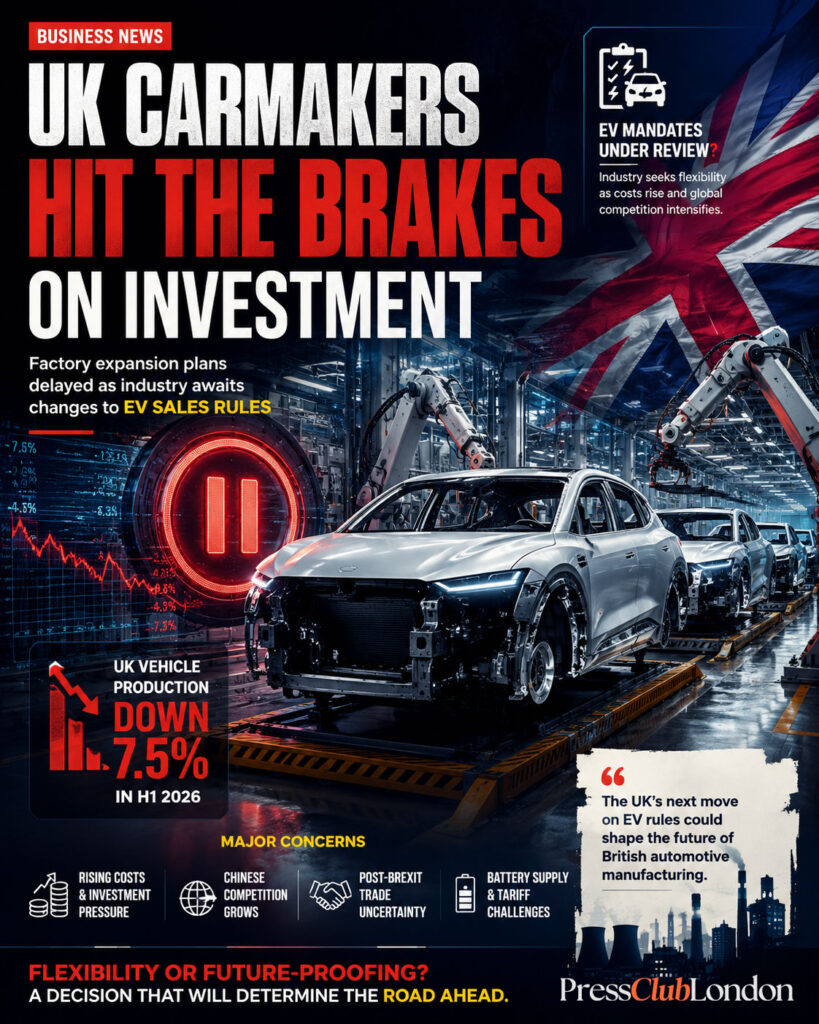
The UK automotive industry is facing a critical moment as major car manufacturers postpone investment decisions in British factories while awaiting potential changes to the government’s electric vehicle (EV) sales regulations. Industry leaders argue that the current rules are creating uncertainty and increasing financial pressure at a time when manufacturers are already dealing with intense global competition and rising production costs.
Why Carmakers Are Holding Back
According to Mike Hawes, Chief Executive of the Society of Motor Manufacturers and Traders (SMMT), several manufacturers with UK operations are interested in launching new vehicle models and expanding production capacity. However, many are delaying final investment commitments until the government clarifies whether it will ease the Zero Emission Vehicle (ZEV) mandate.
The ZEV mandate requires manufacturers to sell an increasing proportion of electric vehicles each year as the UK moves toward its long-term net-zero emissions goals. The policy is designed to accelerate EV adoption and reduce dependence on petrol and diesel vehicles. However, manufacturers argue that the pace of transition is proving difficult due to market realities and consumer demand patterns.
Growing Challenges for the UK Auto Industry
The investment delays come at a difficult time for Britain’s automotive sector. UK vehicle production fell by 7.5% during the first half of 2026, reflecting broader industry pressures. Carmakers are simultaneously facing:
- Increased competition from rapidly expanding Chinese EV manufacturers.
- High costs associated with EV development and battery technology.
- Ongoing uncertainty surrounding post-Brexit trade arrangements.
- Potential tariff and supply chain challenges linked to battery sourcing rules.
Industry observers warn that uncertainty over future regulations could make the UK less attractive for long-term automotive investment compared to other manufacturing hubs.
The Debate Over Relaxing EV Targets
The UK government has indicated it may review and potentially soften some aspects of the EV sales mandate following industry lobbying. Carmakers and trade unions argue that more flexibility would help protect jobs, support factory investment, and maintain competitiveness during the transition to electrification.
However, environmental groups, EV charging companies, and clean transportation advocates strongly oppose weakening the targets. They argue that policy certainty is essential for attracting investment into charging infrastructure and maintaining momentum toward the UK’s climate goals. Critics also warn that slower EV adoption could allow international competitors, particularly Chinese manufacturers, to strengthen their market position further.
What Happens Next?
The government’s decision on the ZEV mandate could significantly influence the future of UK automotive manufacturing. A relaxation of the rules may unlock delayed investments and provide short-term relief for manufacturers. Conversely, maintaining ambitious EV targets could reinforce the UK’s long-term commitment to electrification but may increase pressure on companies already navigating a challenging global market.
As the industry waits for clarity, the outcome will likely determine whether Britain can remain a competitive destination for automotive manufacturing in the electric vehicle era.