Smart glasses are increasingly becoming part of everyday technology, but their ability to record what users see and hear is creating new challenges for institutions where privacy and trust are critical.
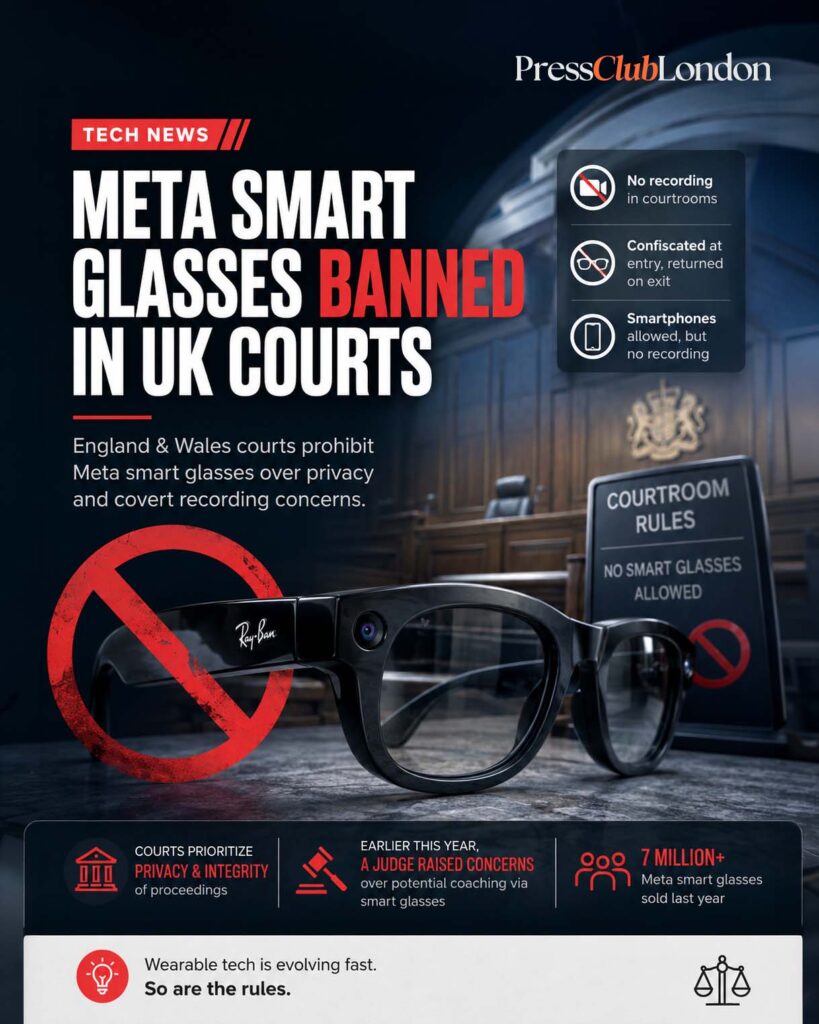
Courts in England and Wales have now taken a clear position. Meta’s smart glasses are prohibited from judicial buildings, with HM Courts & Tribunals Service (HMCTS) confirming that people attempting to enter with the devices will have them confiscated and returned when they leave.
Why are smart glasses being restricted?
The central concern is recording.
Taking photographs or videos inside UK court buildings without official permission is prohibited and can potentially amount to contempt of court. While smartphones are allowed inside courts, they are subject to the condition that they are not used to record proceedings.
Smart glasses create a different challenge because their recording capability is built directly into an ordinary-looking pair of glasses.
HMCTS told the Guardian that existing restrictions on taking images and videos within courts are the reason Meta glasses are prohibited.
For the courts, the issue is therefore less about the brand itself and more about the capabilities of the technology.
A new challenge for courtroom security
The concerns go beyond simply recording court proceedings.
Earlier this year, a claimant appearing in the High Court was accused by a judge of wearing smart glasses and potentially receiving coaching through them while giving evidence. The claimant denied using the glasses to receive answers and also denied that they were connected to his phone.
Even without proving that such technology was being misused, the incident highlights a difficult question: How can a court know what information a person may be receiving through a device that looks like an ordinary pair of glasses?
Traditional security procedures are designed around visible devices such as phones, cameras and recording equipment. Wearable technology makes that distinction increasingly difficult.
The issue isn’t limited to the UK
England and Wales are not alone in responding to the technology.
New York’s court system introduced a similar restriction last month, stating that the objective was to prevent people from secretly recording court proceedings. Smart glasses must be handed over for safekeeping while users remain inside court facilities.
The technology has also attracted restrictions in other public spaces, including restaurants, theatres and pubs, where concerns have focused on people being recorded without their knowledge or consent.
Meta has said its glasses display a visible pulsing light when recording and that it uses tamper-detection technology intended to prevent users from covering the recording indicator.
However, the growing number of restrictions suggests that visible recording indicators alone may not be enough to reassure every organisation or member of the public.
A bigger question for wearable technology
The development raises an important question for the technology industry:
What happens when devices become powerful enough to capture the world around us, but small enough to be almost indistinguishable from everyday objects?
Smartphones changed the way people interact with information. Smart glasses could take that a step further by making cameras, microphones and digital assistants part of the user’s normal field of view.
That creates exciting possibilities, but it also creates new responsibilities around consent, privacy and appropriate use.
For courts, the answer is straightforward: protecting the integrity of proceedings takes priority over convenience.
For technology companies, however, the challenge is much larger. As wearable devices become more common, their acceptance will depend not only on what they can do, but also on whether people feel comfortable being around them.
The court ban may therefore be more than a restriction on one particular product. It could be an early example of how public institutions begin setting boundaries for a new generation of always-connected wearable technology.
The technology may be wearable. The questions around privacy, trust and accountability are much harder to ignore.