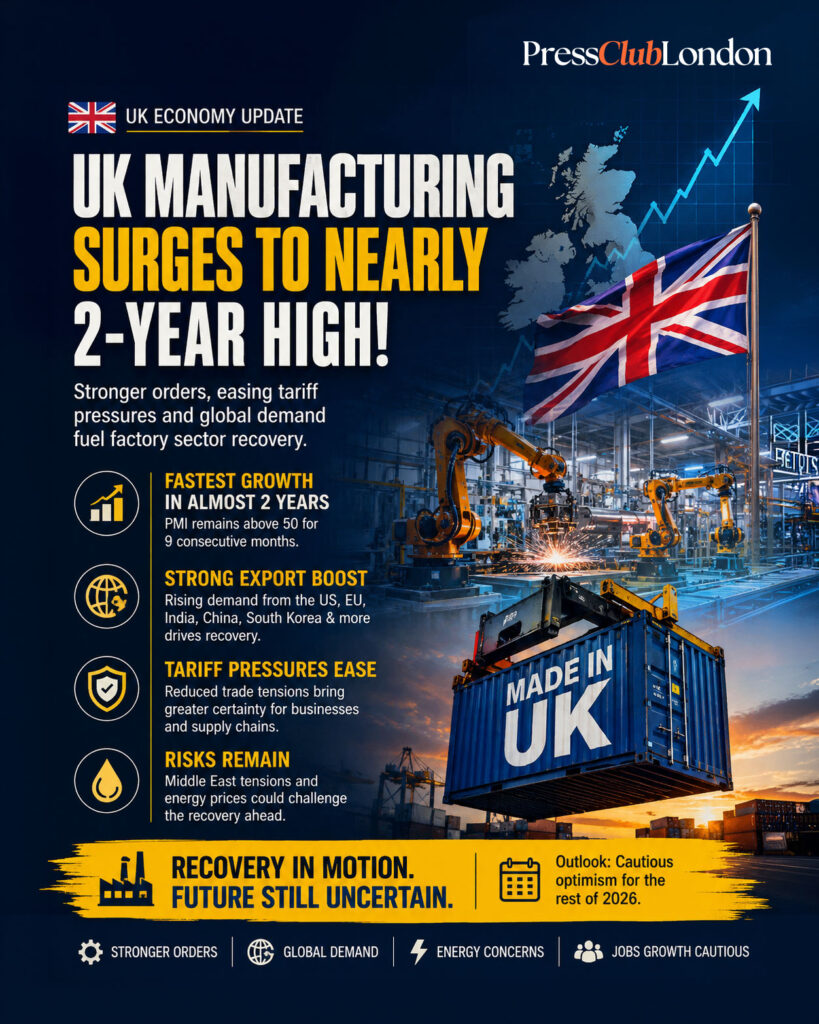
The UK’s manufacturing sector has recorded its fastest pace of growth in almost two years, signaling a notable recovery after a prolonged period of economic uncertainty. According to the latest industry survey data, manufacturing activity expanded for the fourth consecutive month in July, supported by stronger domestic demand, improving export orders, and easing concerns surrounding international trade disruptions.
The recovery comes after manufacturers faced significant challenges over the past two years, including trade tensions linked to U.S. tariff policies under President Donald Trump, supply chain disruptions, and geopolitical instability. While the sector’s Purchasing Managers’ Index (PMI) slipped slightly to 51.9 from 52.5 in June, it remained comfortably above the 50-point threshold that indicates growth. This marks the ninth consecutive month of expansion for British factories.
Export Markets Drive Recovery
A major factor behind the improvement has been the resurgence in new orders from both domestic and international customers. British manufacturers reported stronger demand from key markets including the United States, Canada, the European Union, China, India, and South Korea. Export growth has helped offset weaker conditions in some parts of the global economy and provided businesses with renewed confidence.
The easing of tariff-related uncertainty has also contributed to improved business sentiment. Trade tensions that previously disrupted global supply chains have begun to stabilize, allowing manufacturers to plan production more effectively and secure materials with fewer delays.
Geopolitical Risks Remain
Despite the positive momentum, manufacturers continue to face significant risks. Ongoing tensions in the Middle East, particularly concerns surrounding Iran and the potential impact on oil and gas supplies, remain a major source of uncertainty. Analysts warn that prolonged disruptions could lead to higher energy prices, increased transportation costs, and renewed inflationary pressures across global markets.
Energy-intensive industries are especially vulnerable to any sharp rise in fuel costs, which could undermine profitability and slow the sector’s recovery later this year.
Hiring Growth Still Cautious
While production and orders have increased, employment growth within the manufacturing sector remains limited. Many companies are choosing to remain cautious about expanding their workforce until there is greater clarity on trade policy, inflation trends, and global economic conditions.
Industry leaders have welcomed government efforts to strengthen vocational training and improve industrial competitiveness, but they stress that long-term policy stability will be crucial for sustaining growth.
Outlook
The latest figures suggest that UK manufacturing is regaining momentum after a difficult period marked by tariffs, supply chain challenges, and geopolitical shocks. However, the recovery remains fragile. Rising energy costs, inflation concerns, and geopolitical tensions could still create obstacles in the months ahead.
For now, stronger export demand and improving global trade conditions are providing British manufacturers with a much-needed boost, offering hope that the sector can continue its gradual recovery through the remainder of 2026.