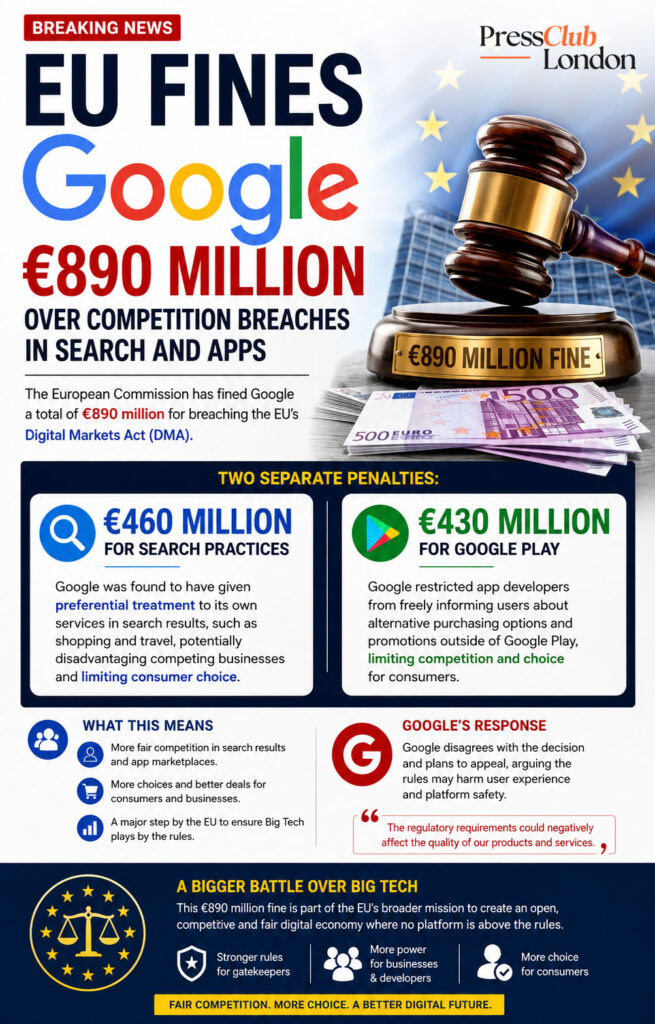
The European Union has imposed a combined €890 million fine on Google after finding that the technology giant breached the bloc’s Digital Markets Act (DMA) through practices involving its search engine and app store.
The European Commission issued two separate penalties: €460 million related to Google’s search practices and €430 million concerning its Google Play app store. The decision represents another major step in the EU’s efforts to hold the world’s largest technology companies accountable for how they use their market power.
Why Was Google Fined?
The first case centres on Google’s search results. According to the European Commission, Google was found to have given preferential treatment to its own services, including areas such as shopping and travel-related services, potentially putting competing third-party businesses at a disadvantage.
The concern is straightforward: when a company controls one of the world’s most widely used search engines while also operating services that compete in the same markets, how those services are displayed can have a significant impact on competitors and consumer choice.
The EU’s position is that digital platforms with significant market power should not use their dominance to unfairly favour their own services over competing providers.
The second penalty focuses on Google Play and the relationship between app developers and consumers. The European Commission found that Google’s rules restricted developers from freely directing users toward alternative purchasing options and promotional offers outside the Google Play ecosystem.
The EU argues that developers should have greater freedom to inform customers about potentially cheaper options and alternative ways to purchase digital services.
What Does the Decision Mean for Consumers?
At the heart of the EU’s action is the principle of consumer choice.
For users, the changes could eventually mean more neutral search results and greater freedom when purchasing digital products and services through apps. For businesses and developers, the decision could create more opportunities to compete without being disadvantaged by the rules of a dominant platform.
The European Commission has also indicated that Google has already been testing changes to its search presentation as part of its efforts to comply with the DMA. However, regulators concluded that the measures taken so far did not fully address their concerns.
Google’s Response
Google has rejected the EU’s conclusions and is expected to appeal the decision. The company has argued that the regulatory requirements could negatively affect the quality of its products and potentially weaken safety measures.
This highlights the wider debate surrounding digital regulation. Technology companies argue that strict rules can make their services less efficient or less secure, while regulators maintain that dominant platforms must operate under rules that protect competition and give users meaningful choices.
A Bigger Battle Over Big Tech
The €890 million penalty is significant, but it is also part of a much broader regulatory shift in Europe.
The EU has increasingly positioned itself as one of the world’s toughest regulators of Big Tech. The Digital Markets Act was created to make digital markets more open and competitive by placing specific obligations on the largest technology platforms, often referred to as “gatekeepers.”
Google is not the only major technology company facing pressure under these rules. Apple and Meta have also faced EU enforcement actions related to the DMA.
The latest Google decision therefore sends a message that Europe’s digital competition rules are not simply theoretical. The European Commission is prepared to impose substantial financial penalties and demand changes to the way major technology platforms operate.
What Happens Next?
Google’s appeal could take the dispute into a longer legal battle, while the company will also need to address the Commission’s concerns about its search and app store practices.
The bigger question is how far regulators will go in reshaping the business models of dominant technology platforms.
For businesses that depend on search engines, app stores and digital marketplaces, the outcome could have lasting consequences. Changes to ranking systems, platform rules and payment policies could influence how companies reach customers, promote their products and generate revenue online.
For consumers, the goal is ultimately simple: more choice, fairer competition and fewer advantages created simply by owning the platform on which the market operates.
The EU’s latest action against Google demonstrates that the battle over the future of the digital economy is moving beyond traditional antitrust investigations. Regulators are increasingly focused on the everyday rules that shape how businesses compete and how consumers discover, buy and use digital products.
As Big Tech continues to influence almost every aspect of the modern economy, the European Union’s approach could become an important model for regulators around the world.